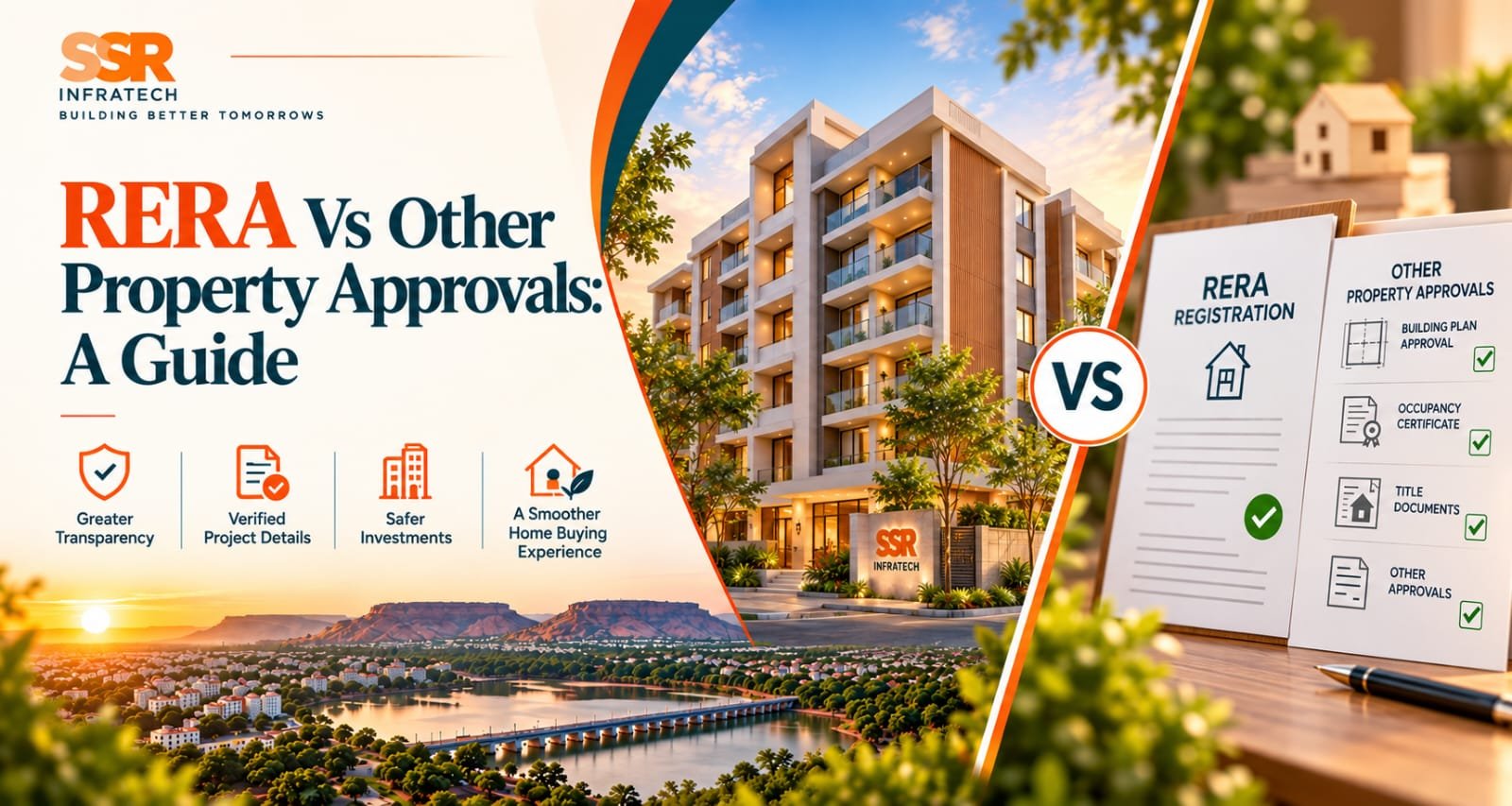
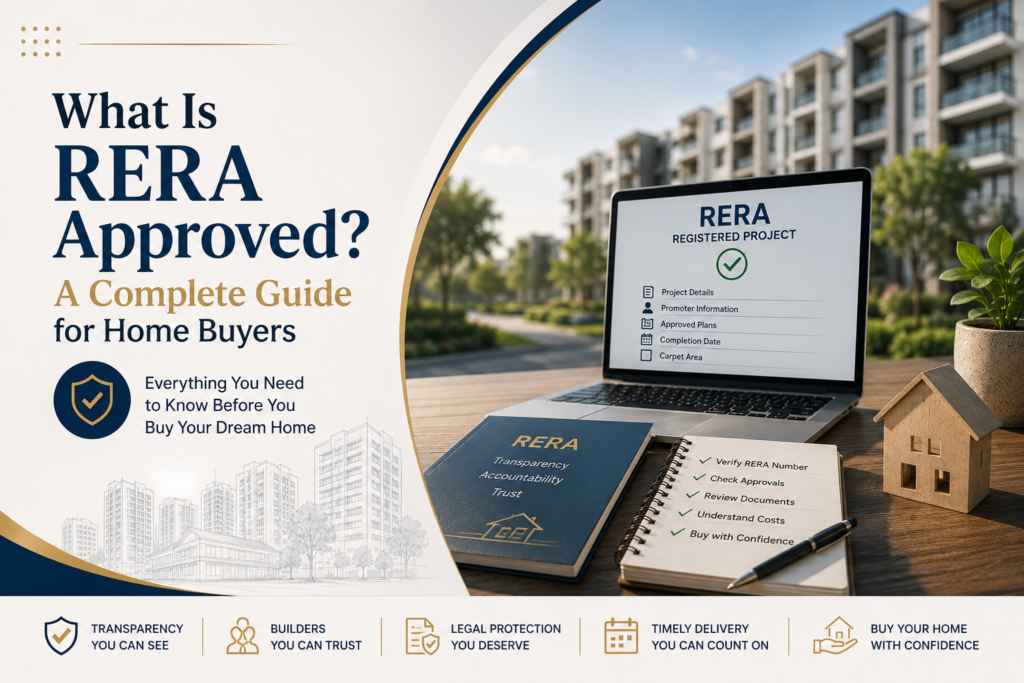
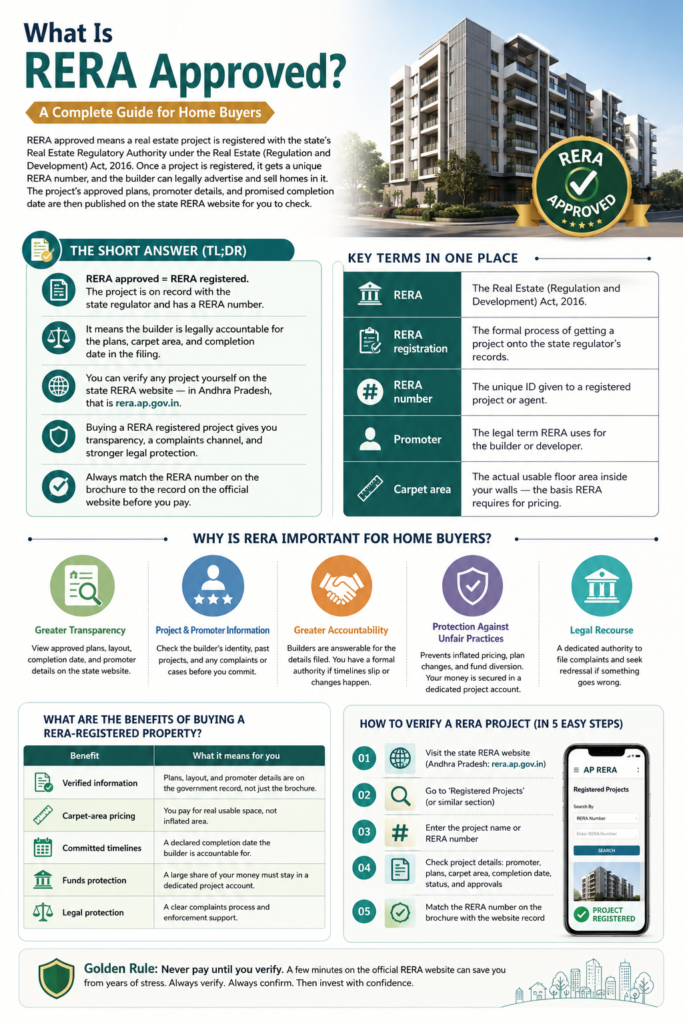
RERA approved means a real estate project is registered with the state’s Real Estate Regulatory Authority under the Real Estate (Regulation and Development) Act, 2016. Once a project is registered, it gets a unique RERA number, and the builder can legally advertise and sell homes in it. The project’s approved plans, promoter details, and promised completion date are then published on the state RERA website for you to check. For a home buyer, RERA approval is the difference between a promise you have to trust and a promise you can verify.
In ten years of building homes in Kurnool, there’s one question we get on WhatsApp almost every single day: “Is this project RERA approved?” It’s usually the first thing a serious buyer asks, and honestly, it should be. So let’s clear it up properly.
RERA approved means the project is registered with your state’s Real Estate Regulatory Authority under the Real Estate (Regulation and Development) Act, 2016. Once that’s done, the project gets its own RERA number, and only then can the builder legally advertise or sell a single unit. Everything about the project — the approved plans, who’s building it, and the date it’s promised to be finished — goes up on the state RERA website for anyone to see. For you, that’s the whole point: instead of taking a builder’s word for it, you can go and check.
This guide walks you through what RERA approval actually covers, why it matters when you’re spending your life’s savings, how to check it yourself in about five minutes, and what to look at before you book a RERA approved apartment. No jargon. We’ll keep it the way we’d explain it to a friend sitting across the table.
The short answer (TL;DR)
- RERA approved = RERA registered. The project is on record with the state regulator and has a RERA number.
- It means the builder is legally accountable for the plans, carpet area, and completion date in the filing.
- You can verify any project yourself on the state RERA website — in Andhra Pradesh, that is rera.ap.gov.in.
- Buying a RERA registered project gives you transparency, a complaints channel, and stronger legal protection.
- Always match the RERA number on the brochure to the record on the official website before you pay.
What Is RERA?
RERA stands for the Real Estate (Regulation and Development) Act, 2016 – a central law passed by the Indian Parliament to regulate the real estate sector and protect home buyers. It came into full force on 1 May 2017.
Before RERA, buyers had little protection when a project was delayed, when the promised area shrank, or when money was diverted to other projects. The Act changed that. It requires most builders to register their projects, disclose the real details, and answer to a dedicated authority in each state.
Every state and union territory has set up its own Real Estate Regulatory Authority and its own RERA website. Andhra Pradesh, where SSR Infratech builds, has AP RERA (rera.ap.gov.in). The rules follow the same central law, with small state-level differences.
What Does “RERA Approved” Mean?
“RERA approved” is the everyday phrase people use for a project that is registered with the state RERA authority. Technically, RERA does not “approve” projects the way a bank approves a loan — it registers them. But the two words are used to mean the same thing in daily conversation.
When a project is RERA approved, it means the builder has submitted the land title and approvals, declared the layout and number of units, committed to a completion date, listed the carpet area of each unit, and received a RERA number that appears on the public register. From that point, the builder can legally market and sell homes — and is legally bound to the details filed.
Key Terms in One Place
| RERA | The Real Estate (Regulation and Development) Act, 2016. |
| RERA registration | The formal process of getting a project onto the state regulator’s records. |
| RERA number | The unique ID given to a registered project or agent. |
| Promoter | The legal term RERA uses for the builder or developer. |
| Carpet area | The actual usable floor area inside your walls — the basis RERA requires for pricing. |
Why Is RERA Important for Home Buyers?
RERA matters because it shifts the balance from the builder to the buyer. Here is what that looks like in practice.
1. Greater Transparency
Every RERA registered project has a public page on the state website. You can see the approved plans, the layout, the promised date, and the promoter’s other projects — without depending only on a glossy brochure.
2. Project and Promoter Information
RERA puts the builder’s identity and history on record. You can check who is behind the project, what else they have built, and whether any complaints or cases are listed against them before you commit.
3. Greater Accountability
Once details are filed, the builder is answerable for them. If the promised completion date slips or the project changes materially, you have a formal authority to approach — not just a sales office that stops answering calls.
4. Protection Against Certain Unfair Practices
RERA curbs practices that used to hurt buyers: selling on inflated super built-up area, quietly changing the plan, and diverting your money to other projects. The Act requires a large share of buyer funds to be kept in a dedicated project bank account so the money is used for the project you paid for.
What Are the Benefits of Buying a RERA-Registered Property?
Choosing a RERA approved property gives you concrete, checkable advantages over an unregistered one:
How to Check Whether a Property Is RERA Registered?
You can verify any project yourself in a few minutes. The full step-by-step method is in the FAQ below under “How can I check a project’s RERA registration?” In short: go to your state RERA website, search by project or promoter name, and confirm the details match what you were told.
A quick tip: a genuine builder will hand you the RERA number without hesitation. If a salesperson dodges the question or says it is “under process,” treat that as a signal to slow down and verify.
What Information Can Home Buyers Check Through RERA?
The state RERA record typically lets you see the project’s registration number and validity, the approved layout and building plans, the promoter’s name and past projects, the promised completion date, the declared carpet area, the status of approvals, and quarterly progress updates. Many states also list any complaints or legal cases attached to the project.
RERA Registration vs RERA Approval – What’s the Difference?
This trips up a lot of buyers, so here it is plainly. RERA registration is the correct legal term: the builder registers the project and receives a RERA number. RERA approval is the informal phrase people use for the same thing. There is no separate “approval certificate” beyond the registration.
So when a builder says a project is “RERA approved,” what you should confirm is that it is RERA registered with a valid, verifiable number on the state website. The words differ; the thing to check is the same.
What To Check Before Buying a RERA-Registered Apartment?
Registration alone is not the finish line — it is the starting point. Before you book a RERA approved apartment, run through this buyer checklist:
| Check | Why it matters |
|---|---|
| RERA number is valid and matches the project | Confirms the project is genuinely registered, not just claimed. |
| Promoter name matches the agreement | Ensures you are dealing with the registered entity. |
| Completion date on the record | Sets the timeline the builder is accountable for. |
| Carpet area matches the brochure and agreement | Protects you from area mismatch later. |
| Approved plan matches what is being sold | No surprise changes to layout or amenities. |
| No adverse complaints or litigation listed | Flags risk before you pay. |
| Amenities in the brochure are in the RERA filing | Only filed amenities are legally promised. |
RERA Carpet Area: What Home Buyers Should Know
One of the biggest wins of RERA is that pricing must be based on carpet area — the actual usable area within the walls of your home, including the internal walls but not the thickness of the external walls, balcony, or shared spaces.
Before RERA, many builders sold on “super built-up area,” which added a share of corridors, lobbies, and stairwells. Two flats with the same “size” could have very different real space. Under RERA, the carpet area must be declared, so you know exactly how much home you are paying for.
Is RERA Registration Mandatory for Every Real Estate Project?
Not for every single project, but for most. Under the Act, a project generally must be registered if the land is more than 500 square metres or if it has more than 8 units. Below that threshold, and for certain repair or renovation work that does not involve fresh marketing or allotment, registration may not be required.
Because states can vary the details slightly, the safest rule is simple: if a project is being actively advertised and sold as new apartments, it should almost always be RERA registered. If it is not, ask why.
What Happens If a Project Is Not RERA Registered?
If a project legally needs registration but does not have it, the builder is operating outside the law and can face penalties. For you as a buyer, the bigger issue is that you lose RERA’s protections — the verified information, the committed timeline, the funds safeguard, and the complaint mechanism.
That does not automatically mean every unregistered project is a scam; a few small projects are genuinely exempt. But it does mean you must find out why a project is unregistered, get legal advice, and be far more cautious before parting with money.
SSR Infratech’s RERA-Registered Projects in Kurnool
At SSR Infratech, RERA compliance is not a marketing line — it is how we have built since 2016. We are a Kurnool-based developer with 100% RERA compliance, CREDAI membership, and an Indian Concrete Institute award for Outstanding Concrete Structure (Residential). Over 1,000 families now live in an SSR home.
Our current residential projects — including Nakshatra and HM Grandeur in Doctors Colony, and Sri Sai Bhageeratha Residency — are RERA-registered 2BHK and 3BHK gated-community apartments. When you enquire, we hand you the RERA number, the registration certificate, and the approved plan up front, so you can verify every detail on AP RERA before you decide.
That is what “built with trust” means to us: documents, dates, and a number you can check — not adjectives.
The SSR trust strip: 100% RERA compliant · CREDAI member · ICI Outstanding Concrete Structure Award (Residential) · 1,000+ families housed since 2016.
Thinking about a home in Kurnool?
Get the RERA number, brochure, price sheet, and approved plan for any SSR Infratech project — sent to you on WhatsApp, no pressure. Chat with us on WhatsApp (wa.me/919994404383) or book a site visit at ssrinfratech.in/contact.
Frequently Asked Questions About
RERA
What is RERA approved?
RERA approved means a real estate project has been registered with the state’s Real Estate Regulatory Authority under the Real Estate (Regulation and Development) Act, 2016. Once registered, the project receives a unique RERA number, and the builder can legally advertise and sell units. The approved plans, timelines, and details are then published on the state RERA website for you to verify.
What does RERA registration mean?
RERA registration is the formal process by which a builder submits project details, approvals, and timelines to the state authority and receives a registration number. It is the legal basis for what people casually call “RERA approval,” and it makes the builder accountable for the promises in the filing — including the completion date and the declared carpet area.
How can I check a project’s RERA registration?
You can verify any project in four steps:
- Identify the relevant state RERA authority. RERA is state-specific. For a project in Andhra Pradesh, use rera.ap.gov.in; other states have their own portals.
- Search for the project. Open the registered-projects section and search by project name, promoter name, or RERA registration number.
- Verify the project details. Confirm the promoter, location, layout, carpet area, and completion date match what you were told.
- Check the registration details. Confirm the RERA number is valid and current, and download the certificate and approved documents for your records.
What is a RERA number?
A RERA number is the unique registration number issued to a project (or agent) by the state authority. It links to the project’s public record, where you can view approved plans, timelines, and promoter details. A genuine RERA registered project always displays its RERA number on ads, brochures, and hoardings.
Is RERA registration mandatory for all projects?
It is mandatory for most projects, but not every one. Generally, projects on land above 500 square metres or with more than eight units must register before being advertised or sold. Small projects below that threshold, and certain repair or renovation work, may be exempt. Rules vary slightly by state, so always check your state authority.
What are the benefits of buying a RERA-registered property?
You get verified project information, a committed completion date, carpet-area pricing, a formal complaints channel, and funds protection through the dedicated project account rule. In short, documented accountability instead of trust-me promises — and banks also lend more readily against registered projects.
Can I buy a property that is not RERA registered?
If a project legally requires registration and does not have it, be very cautious — you lose the Act’s protections and may have limited recourse if the project is delayed or changed. Some small projects are genuinely exempt. Before buying any unregistered project, confirm whether it is exempt or simply non-compliant, and take legal advice.
What should I check on the RERA website before buying a property?
Check the registration status and validity, the promoter’s name and track record, the approved layout and plans, the promised completion date, the declared carpet area, any listed complaints or litigation, and the quarterly progress updates. Make sure every detail matches the brochure and the agreement you are being asked to sign.
RERA approved means a real estate project has been registered with the state’s Real Estate Regulatory Authority under the Real Estate (Regulation and Development) Act, 2016. Once registered, the project receives a unique RERA number, and the builder can legally advertise and sell units. The approved plans, timelines, and details are then published on the state RERA website for you to verify.
RERA registration is the formal process by which a builder submits project details, approvals, and timelines to the state authority and receives a registration number. It is the legal basis for what people casually call “RERA approval,” and it makes the builder accountable for the promises in the filing — including the completion date and the declared carpet area.
You can verify any project in four steps:
- Identify the relevant state RERA authority. RERA is state-specific. For a project in Andhra Pradesh, use rera.ap.gov.in; other states have their own portals.
- Search for the project. Open the registered-projects section and search by project name, promoter name, or RERA registration number.
- Verify the project details. Confirm the promoter, location, layout, carpet area, and completion date match what you were told.
- Check the registration details. Confirm the RERA number is valid and current, and download the certificate and approved documents for your records.
A RERA number is the unique registration number issued to a project (or agent) by the state authority. It links to the project’s public record, where you can view approved plans, timelines, and promoter details. A genuine RERA registered project always displays its RERA number on ads, brochures, and hoardings.
It is mandatory for most projects, but not every one. Generally, projects on land above 500 square metres or with more than eight units must register before being advertised or sold. Small projects below that threshold, and certain repair or renovation work, may be exempt. Rules vary slightly by state, so always check your state authority.
You get verified project information, a committed completion date, carpet-area pricing, a formal complaints channel, and funds protection through the dedicated project account rule. In short, documented accountability instead of trust-me promises — and banks also lend more readily against registered projects.
If a project legally requires registration and does not have it, be very cautious — you lose the Act’s protections and may have limited recourse if the project is delayed or changed. Some small projects are genuinely exempt. Before buying any unregistered project, confirm whether it is exempt or simply non-compliant, and take legal advice.
Check the registration status and validity, the promoter’s name and track record, the approved layout and plans, the promised completion date, the declared carpet area, any listed complaints or litigation, and the quarterly progress updates. Make sure every detail matches the brochure and the agreement you are being asked to sign.
Conclusion
RERA approval turns home buying from an act of blind trust into a decision you can verify. It gives you a public record, a committed timeline, carpet-area pricing, and a real authority to turn to if things go wrong. Before you pay for any apartment, do one thing above all: get the RERA number and check it yourself on the state website.
At SSR Infratech, we make that easy — every project comes with its RERA number and documents handed to you up front. That is the whole idea behind homes built with trust, designed with intention, and delivered with integrity.