So, if you are planning to buy an apartment in Kurnool, don’t stop at asking, “Is this project RERA registered?” Ask what else you need to verify.
What Is RERA Registration?
RERA stands for the Real Estate (Regulation and Development) Act, 2016. It was introduced to regulate the real estate sector, improve transparency and protect the interests of home buyers.
Under the Act, eligible real estate projects generally need to be registered with the relevant state RERA authority before being advertised or sold, subject to applicable exemptions. In Andhra Pradesh, this is handled by AP RERA. The AP RERA handbook states that projects within the Act’s scope must be registered before advertising them for sale. RERA AP
RERA registration also requires promoters to submit substantial project information. Depending on the project, this can include land details, sanctioned plans, approvals, project timelines, apartment details and legal documents. RERA AP
You can read our detailed guide to what RERA registration means before checking a project.
For you as a buyer, the practical takeaway is simple: use the applicable RERA portal to verify what the promoter has officially declared rather than relying only on sales material.
Is RERA Registration the Same as Property Approval?
No. RERA registration is not the same as obtaining every property approval.
This is where many buyers get confused.
A project may require several permissions and documents from different authorities. A building plan approval, for example, relates to the construction plan sanctioned by the competent authority. An Occupancy Certificate deals with occupation of a completed building, where applicable.
In fact, the Andhra Pradesh RERA registration requirements specifically ask promoters to submit building sanction plans, commencement certificates, applicable approvals and other permissions. That tells you something important: RERA registration and those approvals are separate components of the project’s documentation. RERA AP
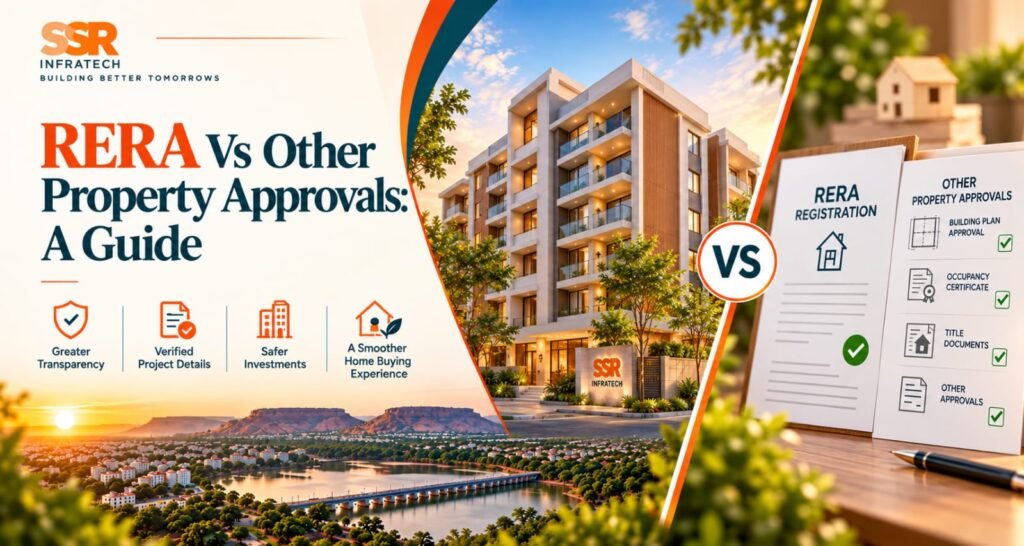
RERA vs Other Property Approvals: What’s the Difference?
Think of your property documents as answering different questions:
Document or approval | What you are checking |
RERA registration | Has the eligible project been registered with the applicable RERA authority? |
Title documents | Does the promoter have the required rights over the land? |
Encumbrance records | Are there registered encumbrances or interests affecting the property? |
Building plan approval | Has the proposed construction been sanctioned by the competent authority? |
Commencement approval/certificate | Can the development or construction proceed under the applicable rules? |
Completion Certificate | Has the project been completed in accordance with the sanctioned plans, where applicable? |
Occupancy Certificate | Is the completed building permitted for occupation, where applicable? |
Agreement for Sale | What exactly have you and the promoter agreed to? |
Sale Deed | How is ownership conveyed to you? |
The Andhra Pradesh RERA rules themselves require project registration documentation covering title, encumbrances, building plans, commencement certificates, applicable approvals, occupancy/completion documentation and legal agreements. RERA AP
That is why checking only one document gives you only part of the picture.
What Does RERA Registration Tell a Home Buyer?
Project Details
The RERA record can help you check the project’s registered name, location, land details, development information, proposed completion date and other declared particulars.
AP RERA’s project registration form also captures details such as the building/layout plan number, project start date, proposed completion date, built-up area and parking information. RERA AP
Promoter Information
You can verify the registered promoter and compare that information with the entity mentioned in your booking documents and agreement.
Project Status and Disclosures
RERA records can help you understand what has been declared about the project and its progress. This gives you another source against which you can compare what the sales team tells you.
Declared Project Details
This is particularly useful when you are comparing the brochure, floor plan and agreement.
If an amenity, configuration, timeline or other material detail differs from what has been officially declared, don’t simply assume it is a harmless difference. Ask for clarification and supporting documentation.
What Other Documents Should Home Buyers Check?
RERA registration is a starting point, not the entire legal due-diligence process.
Title and Ownership Documents
Start with the land. You want to understand who owns it and whether the promoter has the legal right to develop it.
AP’s RERA rules require title documentation and, where applicable, agreements showing the promoter’s rights when the land is owned by someone else. RERA AP
Encumbrance Certificate
An Encumbrance Certificate or other relevant encumbrance records can help you identify registered claims or transactions affecting the property for the period covered.
Approved Building Plan
Check the sanctioned plan and compare it with what you are being offered.
Look beyond your apartment. If parking, amenities, common areas or other facilities are important to your purchase, understand how they appear in the approved project documentation.
Completion and Occupancy Certificates
For a completed project, ask for the applicable completion and occupancy documentation.
The AP RERA handbook distinguishes between the two: a Completion Certificate relates to completion of the project according to the sanctioned plans, while an Occupancy Certificate relates to occupation of the building and civic infrastructure such as water, sanitation and electricity. RERA AP
Sale Agreement and Sale Deed
Don’t treat these as paperwork to skim through at the end.
The Sale Agreement sets out the contractual terms of your purchase. The Sale Deed is the instrument through which ownership is conveyed, subject to the transaction and applicable law.
For a more detailed buyer checklist, see our guide on documents to check before buying an apartment.
Why Should Buyers Check More Than One Approval?
Because no single document answers every question about a property.
RERA can tell you about the project’s registration and declared information. The title documents address land ownership and rights. The sanctioned plan tells you what construction has been approved. Completion and occupancy documents address the status of the completed development.
The checks work together.
For example, you might find a project on the RERA portal and still need to check whether the apartment being offered to you corresponds with the sanctioned plans and contractual documents.
RERA Registration vs Building Plan Approval
RERA registration does not replace building plan approval.
The sanctioned building plan comes from the competent authority under the applicable local planning and building regulations. AP RERA’s registration requirements separately ask promoters to submit the building sanction plan and commencement certificate. RERA AP
So when you see a RERA number, don’t interpret it as “every aspect of this building has been approved by RERA.”
It means something more specific: the eligible project has been registered under the RERA framework and has submitted the required information and documents to the authority.
RERA Registration vs Occupancy Certificate
These serve different purposes too.
RERA registration: relates to registration and regulatory disclosures for the eligible real estate project.
Occupancy Certificate: relates to occupation of a completed building, where such certification is applicable.
The RERA framework itself gives allottees the right to obtain information relating to sanctioned plans and other project information. It also refers to possession in relation to an Occupancy Certificate. India Code
So, if you are buying a ready-to-move-in apartment, don’t assume that the project’s RERA registration answers your questions about occupation. Check the applicable completion and occupancy documentation separately.
What Should You Verify Before Buying an Apartment in Kurnool?
Before you book, work through these checks:
- Verify the RERA details on the official AP RERA portal.
- Verify title and ownership of the land.
- Check applicable building approvals and sanctioned plans.
- Check the project’s status and declared timeline.
- Review completion and occupancy documentation, where applicable.
- Compare the documents with the actual property being offered.
- Read the Agreement for Sale carefully before signing.
- Get professional legal verification where necessary.
SSR Infratech’s buyer information also emphasises documentation clarity and support with legal paperwork, home loans and property transactions. SSR InfraTech
If you’re evaluating a specific project, you can also explore SSR Infratech’s residential projects in Kurnool and review the project information available for each development.
Common Misconceptions About RERA and Property Approvals
“If a project has RERA registration, I don’t need to check anything else.”
You still need to carry out property due diligence. RERA registration does not make title documents, sanctioned plans or applicable completion and occupancy documentation irrelevant.
“RERA registration and building approval are the same.”
They are not. Building approval relates to sanctioned construction; RERA registration relates to the project’s registration and disclosures under the RERA framework.
“All property projects require exactly the same documents.”
Not necessarily. Requirements can depend on the type, location, stage and characteristics of the project and the applicable local laws.
“The builder’s brochure is enough.”
A brochure is useful for understanding what is being offered. It should not be your only source of verification.
Compare it with official records and the contractual and approval documents.
RERA and Other Approvals: A Simple Buyer Checklist
Before you sign, tick these off:
☐ RERA registration/details
☐ Title/ownership documents
☐ Encumbrance-related records
☐ Approved building plan
☐ Applicable commencement approval
☐ Applicable completion documentation
☐ Occupancy Certificate, where applicable
☐ Other project-specific approvals
☐ Agreement for Sale
☐ Sale Deed
☐ Property/maintenance dues, where relevant
This section would work particularly well as an infographic because a buyer can save it and use it during a site visit or document review.
Frequently Asked Questions
1. Is RERA registration the same as building plan approval?
No. RERA registration and building plan approval are separate. The RERA registration process can require the promoter to submit the sanctioned building plan and related approvals. RERA AP
2. Does RERA registration mean a property has all approvals?
No. Treat RERA registration as one important verification point, not as a substitute for checking every approval applicable to the project.
3. What documents should I check before buying an apartment?
Check RERA details, title and ownership documents, encumbrance records, sanctioned building plans, applicable approvals, completion/occupancy documents and your Agreement for Sale and Sale Deed.
4. Do ready-to-move apartments need an Occupancy Certificate?
Where an Occupancy Certificate is required under the applicable rules, you should verify it before taking possession. The exact documentation can depend on the project and competent authority.
5. How can I verify whether an apartment project is RERA registered?
For a project in Andhra Pradesh, search the project or promoter through the official AP RERA portal. Match the RERA details with the project information and documents given to you by the promoter.